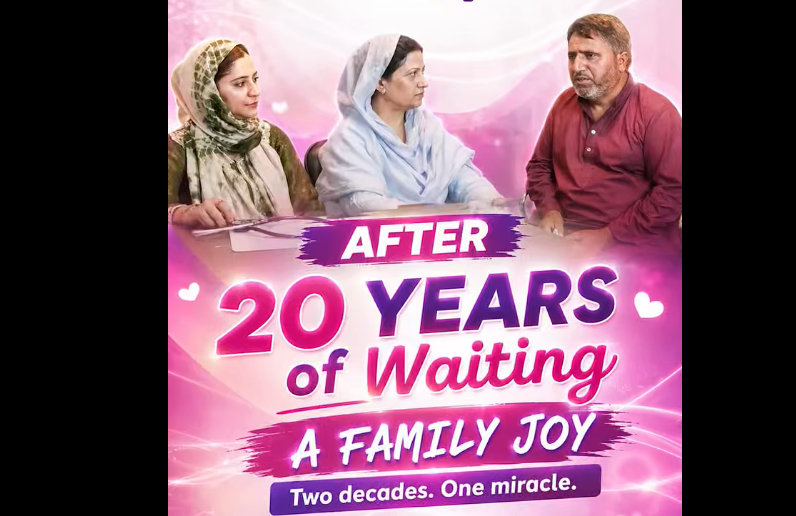
By Tariq and Mehnaz (as narrated to our care team at Rotunda Hygeia)
The Long, Silent Wait
For twenty years, our home was filled with a quiet that felt heavier than any sound.
People outside see a house, but those battling infertility know that a home without the patter of little feet is just a building. For two decades, Mehnaz and I lived in the shadow of “someday.” Every wedding we attended, every family gathering where someone whispered about someone else’s newborn, every festival where the elders blessed us with “May God fill your laps soon”—each one felt like a gentle tightening of a knot around our hearts.
We married young, full of dreams. The first few years, we brushed off the delays. “It will happen when it’s time,” we told ourselves. But time didn’t wait. Years turned into a decade, and that decade stretched into a second.
We became veterans of hope and heartbreak. We traveled from clinic to clinic, city to city. We met doctors who looked at file folders thicker than novels with weary, dismissive eyes. And every time the blood test report flashed “Negative,” a piece of our spirit broke away.
By the time we walked through the doors of Rotunda Hygeia in Srinagar, we weren’t just tired—we were empty. We had low AMH, PCOD, and severe male factor infertility stacked against us like a mountain that no human could climb.
This is our story of how that mountain finally moved.
The Triple Diagnosis: When Hope Felt Impossible
Looking back, our medical file read like a textbook of reproductive roadblocks. It wasn’t just one issue; it was a compounding storm of challenges that every previous doctor told us left us with virtually zero chance of using our own gametes.
1. The PCOD Wall
For Mehnaz, Polycystic Ovarian Disease (PCOD) meant her cycles were a battlefield of irregularity and unpredictable hormonal chaos. Month after month, her body fought itself. Ovulation was a rare, elusive guest.
2. The Low AMH Reality
If PCOD wasn’t enough, testing revealed a plummeting Anti-Müllerian Hormone (AMH) level. At our age, after years of failed stimulations and medical exhaustion, her ovarian reserve was critically depleted. Doctor after doctor shook their heads: “With Low AMH and PCOD combined, your eggs are few in number and poor in quality. Donor eggs are your only practical route.”
Every time we heard those words, Mehnaz would quietly cry herself to sleep. We didn’t just want a child; we wanted a piece of our shared love, a continuation of our journey together.
3. The Male Factor Silence
To compound our grief, my own reports delivered a devastating blow. Severe male factor infertility—low count, poor motility, and high morphology issues. In a society where male fertility is rarely spoken of openly, the guilt I carried was suffocating. I felt I had failed the woman who had stood by my side through two decades of weeping storms.
We were told we were “too complex,” “too old,” and that our case was “a closed chapter.” We spent nights asking, “Why us? What did we do to deserve a home so silent?”
Finding Rotunda Hygeia: Where Science Met Empathy
A family member whispered about Rotunda Hygeia in Srinagar. They spoke of advanced fertility care, cutting-edge technology, and—most importantly—doctors who didn’t look at patients as case numbers, but as human beings carrying heavy crosses.
With our hearts in our mouths and our expectations touching the floor, we booked our first consultation. We expected the usual routine: a quick glance at our old files, a sigh, and a gentle rejection.
Instead, we met Dr. Ruheel Nisa and the embryology experts at Rotunda Hygeia.
What happened in that consultation changed everything. For the first time in twenty years, no one sighed. No one rushed us out of the room. The specialist looked at our mountain of old reports, looked right into our eyes, and said:
“Twenty years is a long time to carry pain. But your body is not broken beyond repair; it has just been mismanaged. Low AMH and PCOD require precision, not panic. And male factor requires advanced lab mastery, not guesswork. We cannot promise miracles, but we can promise science, dedication, and fighting by your side until our last effort.”
For the first time in two decades, hope didn’t feel foolish. It felt possible.
The Tailored Protocol: Breaking Down the Mountain
Rotunda Hygeia didn’t use a cookie-cutter approach. They understood that standard IVF protocols would fail in a complex case like ours. They designed a bespoke, multi-layered treatment plan specifically for Mehnaz’s depleted reserve and my male factor hurdles.
Step 1: Priming and Gentle Ovarian Stimulation
Because of Mehnaz’s low AMH and PCOD, standard high-dose stimulation would have resulted in poor-quality eggs or ovarian hyperstimulation risk. The fertility specialists at Rotunda Hygeia utilized a micro-dose protocol combined with specialized priming agents. They monitored her follicular growth with hawk-like precision, tweaking medications day by day.
“We aren’t looking for quantity; we are hunting for gold,” the lead embryologist told us after a scan. Out of a challenging environment, the retrieval yielded precious, high-grade oocytes. It felt like a miracle already—but the real battle was yet to come.
Step 2: Advanced Andrology and Micro-Fluidic Sperm Sorting
On the day of retrieval, the pressure on me was immense. My previous parameters were grim. But Rotunda Hygeia’s state-of-the-art andrology lab utilized advanced sperm preparation techniques, including micro-fluidic sperm sorting, to isolate the strongest, most genetically pristine sperm swimmers, bypassing cellular fragmentation.
Using ICSI (Intracytoplasmic Sperm Injection), the expert embryologist expertly injected the selected sperm into Mehnaz’s precious eggs.
Step 3: The Embryo Watch and the Waiting Room
Those next five days in the embryonic incubator were the longest of our lives. Every morning, my phone buzzing with an update from the lab felt like a verdict on our entire marriage.
On day three, we received the call: “Your embryos are dividing well.” On day five, the golden words arrived: “We have healthy blastocysts ready for transfer.”
The Positive Test That Stopped Time
The two-week wait after the embryo transfer was agonizing. We prayed every tahajjud night, tears soaking our prayer mats. We pleaded with the Almighty to let us experience the joy that everyone else took for granted.
On the 14th day, we went back to Rotunda Hygeia for the beta-hCG blood test.
We sat in the waiting lounge, holding hands so tightly our knuckles turned white. When the nurse called us into the consultation room holding a white paper, time seemed to stop completely.
She smiled—a wide, radiant smile that said everything before a single syllable was spoken.
“Congratulations. You are pregnant. The beta levels are strong and exceptional.”
Mehnaz burst into loud, uncontrollable sobs, burying her face in her hands. I sat frozen, staring at the paper, the twenty years of silent rooms, negative tests, rejection, and heartbreak washing away in a single, overwhelming wave of grace. We wept openly in that room—not tears of sorrow, but tears of pure, unadulterated deliverance.
Holding Our Miracle: Life After Twenty Years
Nine months later, the silence in our home was shattered forever by the sweetest sound on earth: the newborn cry of our healthy baby.
Holding our little one in my arms for the first time, looking at Mehnaz’s face glowing with a mother’s fierce, exhausted joy, I realized what patience truly means. We lost twenty years, yes—but we gained a lifetime of tomorrows.
Today, as we watch our child sleep peacefully, our hearts overflow with boundless gratitude. We owe this miracle to the Almighty, and to the extraordinary hands, minds, and hearts at Rotunda Hygeia.
Why We Tell Our Story: A Message to Couples in the Dark
If you are reading this and you have been told:
- “Your AMH is too low.”
- “Your PCOD makes natural or IVF success impossible.”
- “Male factor infertility leaves you with no options.”
- “You have waited too long; it’s too late.”
Please listen to us: Do not give up until you have walked through the doors of Rotunda Hygeia.
While other clinics saw complications, roadmaps of failure, and statistical impossibilities, Rotunda Hygeia saw human beings deserving of a family. They brought together world-class embryology, state-of-the-art technology, and an uncommon, deeply human empathy that healed not just our reproductive organs, but our wounded souls.
After twenty years of darkness, we found our sunrise at Rotunda Hygeia. For anyone struggling with complex infertility in Kashmir and beyond, look no further. Your miracle is waiting there.
Are you or someone you love navigating a difficult fertility journey after years of heartbreak? Reach out to the specialists at Rotunda Hygeia, Srinagar, and take your first step toward the family you deserve.
